
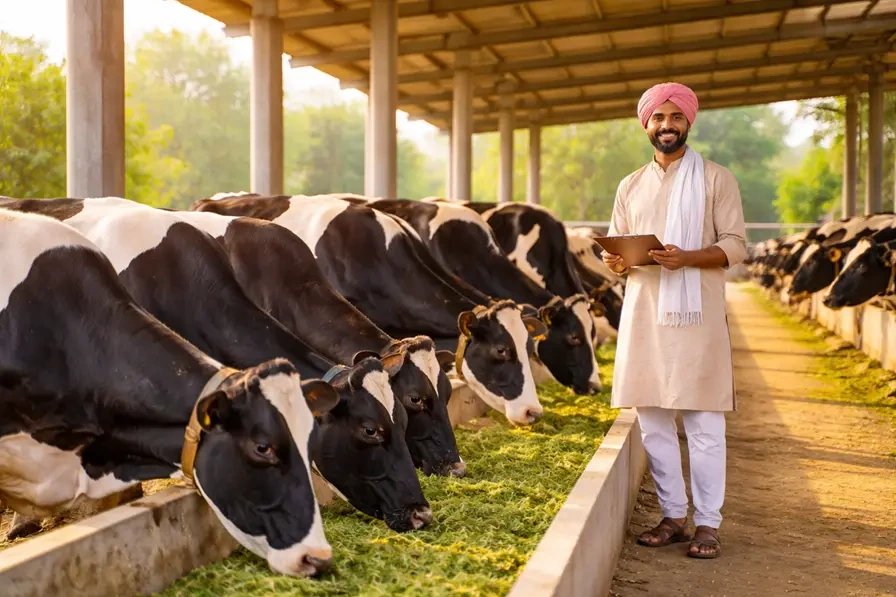
The Market Opportunity
India is the world’s largest milk producer — and its dairy market is undergoing a structural shift towards organised, D2C distribution. Consumers increasingly prefer quality-verified, subscription-based dairy delivered directly to their door over the traditional kirana store purchase.
The shift is creating significant opportunities for organised milk delivery businesses that combine quality sourcing with reliable, technology-enabled operations:
- India produces over 220 million tonnes of milk annually (NDDB, 2023–24)
- The D2C dairy segment is growing at 15–20% CAGR
- Urban consumers increasingly pay a 15–30% premium for quality-verified, home-delivered dairy
- Subscription models create predictable revenue and high customer lifetime value relative to other food categories
Choosing Your Business Model
Before anything else, decide which delivery model you want to operate. Each has different capital requirements, margin profiles and operational complexity.
| Model | Description | Margin | Best For |
|---|---|---|---|
| Collection | Collect from small farmers, deliver under your brand | 12–20% | Low-capital entry, fastest to launch |
| Farm to Home | Own or partner with a farm — direct supply chain | 25–45% | Premium positioning, quality control |
| Multi-Brand | Multiple brands alongside your own private label | 15–30% | Higher basket value, existing customer base |
| Multi-Category | Dairy + fruits, vegetables and grocery in one subscription | 20–35% | Maximum revenue per customer per delivery |
Farmery started as a dairy subscription brand and later expanded into fresh fruits and vegetables using MilkMaster’s multi-category modules. Fresh produce now accounts for 25% of total revenue — all managed from a single platform.
Legal Registration & Licensing
Starting a milk delivery business in India requires several registrations. Requirements vary by state, but these are standard across most:
- Business Registration: Proprietorship, Partnership, LLP or Private Limited Company. If you plan to scale significantly, Private Limited is recommended from the outset.
- FSSAI License: Mandatory for any food business. Central FSSAI License if turnover exceeds ₹20 crore; State License for smaller operations.
- GST Registration: Note that fresh milk is GST-exempt, but value-added dairy products (curd, paneer, butter, ghee) carry applicable rates.
Engaging a local CA or business registration service early saves significant time and avoids compliance gaps that are expensive to fix later.
Sourcing Your Supply
Your supply chain is your most critical quality differentiator. Customers choose — and stay with — a dairy delivery service primarily based on product consistency and reliability. One bad week of quality issues can undo months of acquisition work.
Sourcing Options
- Direct from farmers — local sourcing with quality control challenges; requires cold chain and daily testing
- Large dairy farms — quality differentiation and fresher product; lower logistics complexity
- A2 milk farms — premium segment with 40–80% higher selling price; growing demand in tier-1 cities
- Organic dairy farms — fastest-growing segment with significant pricing power; requires organic certification
Supply Chain Non-Negotiables
- Milk chillers at your depot from day one — not optional
- Daily quality checks with fat content testing equipment
- Backup sourcing agreements to handle supply disruptions without affecting customers
- Packaging choice (poly bags, HDPE bottles, glass) directly impacts brand positioning
Choosing Your Delivery Area
Starting with a tightly defined delivery area is one of the most important early decisions you’ll make. Expanding too broadly before you have sufficient density is a common reason early-stage dairy businesses struggle with unit economics.
- Start with a single ward, colony or 2–3 adjacent residential societies
- Target a maximum 15–20 minute travel between your farthest two stops in the initial zone
- Aim for at least 50 customers per square kilometre before expanding to adjacent areas
- Apartment buildings are high-value targets: a single tower with 200 flats is a concentrated delivery opportunity with low route cost per delivery
- Map existing competition and identify underserved areas where quality delivery is absent or inconsistent
Setting Your Pricing
Pricing for a dairy delivery business involves balancing customer acquisition, long-term retention and sustainable margins.
Cost Build-Up
- Milk procurement (typically 55–70% of selling price)
- Packaging (3–8%)
- Delivery cost per litre: labour + vehicle amortisation (8–15%)
- Platform and software fees
- Customer acquisition cost amortised over expected customer lifetime
- Overheads: depot rent, electricity, admin
Pricing Tactics That Work
- Free trial: A 3–7 day free trial converts better than a discount — it removes the commitment barrier entirely
- Prepaid discount: 2–5% off for 30-day or 90-day subscriptions improves cash flow significantly
- Referral programme: Dairy subscriptions spread naturally via neighbour referrals — build referral incentives into your economics from the start
- Bundle pricing: Milk + curd or milk + ghee at a slight combined discount increases average basket value
Setting Up Operations
Staffing Benchmarks
- Delivery personnel: 1 agent can handle around 50 stops per morning run in a well-organised zone
- Hub manager: Needed from ~300 customers to manage packing, dispatch and cash collection oversight
- Customer support: From ~500 customers, a dedicated person prevents the churn that comes from unresolved complaints
- Operations manager: From ~1,000 customers to coordinate multi-route operations
Equipment Checklist
- Milk chiller or cold room (essential from day one)
- Bulk milk cans and stainless steel dispensing equipment
- Weighing scales and fat testing equipment for daily quality checks
- Delivery vehicles: bicycles for dense urban zones, scooters for larger areas
- Insulated delivery bags or crates to maintain cold chain during delivery
Technology: Your Most Important Early Decision
The technology platform you choose shapes your operations, customer experience and growth trajectory for years. Many founders wait until they have “enough customers” before implementing proper software — and then face a painful, disruptive migration later.
- Customer data is captured correctly from the start — no messy migration from spreadsheets later
- Billing is accurate, automated and reconciled from Day 1
- Your operations team has tools that scale without proportionally scaling headcount
- You build habits and processes on a proper platform — not on workarounds that become technical debt
Aapka Doodhwala launched in 2024 with a small team. By building on MilkMaster from day one, they reached 1,000+ daily orders within their first year — without needing to rebuild their operations infrastructure as they grew.
What Your Dairy Platform Must Cover
- Subscription management with all frequency and pricing configurations
- Mobile app for your delivery team — offline-capable
- Customer-facing branded app on iOS and Android
- Automated billing, wallet system and payment gateway integrations
- Daily reconciliation and MIS reports
- CRM with churn prevention tools and complaint management
Getting Your First 100 Customers
The first 100 subscribers are always the hardest. Here are the tactics that consistently work for early-stage dairy businesses:
- Apartment society WhatsApp groups: Offer the group admin a free 3-day trial in exchange for a group post. This reliably generates 10–30 trials per building — with no ad spend.
- Referral incentives: Give existing trial customers ₹50–100 wallet credit per successful referral conversion.
- Society gate activation: Stand at the gate during morning peak hours (6–8 AM) with small samples. Meeting customers at the exact moment of relevance works.
- Residential Facebook and WhatsApp groups: A clear offer with a simple sign-up flow converts well in local groups.
- Kirana store partnerships: Small commission on referred customers — low cost, high local trust.
Scaling Beyond 500 Customers
Once you’ve validated your model and crossed 300–500 customers, you’re ready to scale thoughtfully. The core principles for this phase:
- Standardise before you expand: Document every process and make sure operations are fully repeatable before adding new zones or cities. Ad hoc processes don’t scale.
- Invest in your delivery team: Delivery agents who know customers personally have a disproportionate impact on retention.
- Use your data: Your platform should show which customers are at churn risk, which zones have the highest acquisition rates and where route efficiency is weakest. Act on it weekly.
- Expand concentrically: Add adjacent delivery zones before entering entirely new areas. Geographic concentration keeps route costs low.
- B2B adds revenue density: Offices, cafes and hotels in your delivery zones generate significant incremental revenue at low additional delivery cost — and they rarely churn.
Happy Nature scaled from 1,200 customers in Delhi NCR to 10,000+ across 8–9 cities by following exactly this approach — using MilkMaster’s platform to scale operations without proportionally growing their team.
Starting or scaling a milk delivery business?
Get a free consultation with MilkMaster’s dairy operations experts. We’ve helped 200+ brands — from raw startups to 10,000+ daily order operations — launch, grow and scale profitably.